Fruit Fly Drain Cleaner: Bar Sink Drains
Quick Answer: For flies breeding in a bar sink drain, clean the slime they feed in. Oregon State University Extension recommends a bacterial or enzymatic drain cleaner followed by hot water, and says to avoid caustic drain cleaners, which it finds less effective. Follow the product label, and in a food business the label must allow that use. Keep bottles, garnish, ice and clean glassware out of the splash.
A drain is one of the most common hidden sources of small flies behind a bar, and it is easy to miss. This post covers how to confirm the drain is the problem, what kind of cleaner the extension sources point to, how often to clean, and what to keep away from open bottles while you do it. Other sources are mapped in where bar fruit flies come from, and the full routine is in getting rid of fruit flies in a bar.
How do you know the flies are coming from the drain?
Cover it and see. Oregon State University Extension (checked September 2026) says to cover the opening overnight, or for a few days, with clear tape or a clear container with a sticky card taped inside, and to check what emerges. Flies can come from more than one place, so test every drain. Oregon State also says the slime that builds in floor and sink drains, overflow drains and garbage disposals supports both drain flies and one fruit fly species that is strongly attracted to it. If you are not sure which fly you have, read our post on fruit gnats and fruit flies.
What kind of drain cleaner works on fruit flies?
The sources point to biological cleaners, not caustic ones. Oregon State says to routinely deep clean floor drains with a bacterial or enzymatic drain cleaner, followed by hot water, and to avoid caustic drain cleaners such as lye-based products, which it says are not as effective as enzymatic cleaners. The Texas A&M AgriLife Extension small flies plan (checked October 2026) also recommends biologically based drain and surface cleaners, and says foam formulations are particularly effective in drains. For drain slime that supports phorid flies, Oregon State says bleach and other disinfectants are not effective, and that bleach combined with hot water releases dangerous chlorine gas. Both documents are written for school kitchens. No brand is recommended here. Use the label of whichever product you choose.
How often should a bar clean its drains?
More often than most bars do. The two sources give different intervals, so the table lists both.
| Task | Interval the source gives | Source |
|---|---|---|
| Wash floor sink catch baskets | Daily | Oregon State PNW 770 |
| Clean drains, traps and strainers | At least twice per week | Texas A&M AgriLife |
| Deep clean floor drains with an enzymatic or bacterial cleaner, then hot water | Routinely, no number given | Oregon State PNW 770 |
| Keep P-traps full of water | Ongoing | Texas A&M AgriLife |
| Re-test by covering the drain overnight | After cleaning | Oregon State PNW 770 |
What should you keep away from open bottles when treating a drain?
Everything that could splash. The FDA Food Code 2026 (§7-202.12, checked September 2026) says a pesticide must be used under label instructions that state the use is allowed in a food establishment, and applied so that drip, drain, fog, splash or spray does not contaminate food, equipment or utensils. Drain cleaners that are not pesticides still deserve the same caution, and the product label governs either way. Oregon State adds a warning on scrubbing: do manual cleaning of a drain with a stiff brush only when the kitchen is not in use, because brushes and scrapers can aerosolize Listeria in moisture droplets that settle on surfaces. Clean and disinfect food contact surfaces and equipment afterward. In a bar, that means moving or covering bottles, garnish and glassware before you start, and cleaning the area after.
When is a drain cleaner the wrong fix?
When the drain is not the source, when the drain is hidden under fixed equipment and never checked, or when the problem is a leak. Texas A&M says a persistent phorid fly problem can point to a broken sewage line that a plumber should inspect. Oregon State says to check drains hidden under fixed equipment and dishwashing areas. If the cover test shows nothing, look at fruit, recycling and drip trays instead.
Where the Esatto Liquor Pourer with Screen, 12 Pack fits
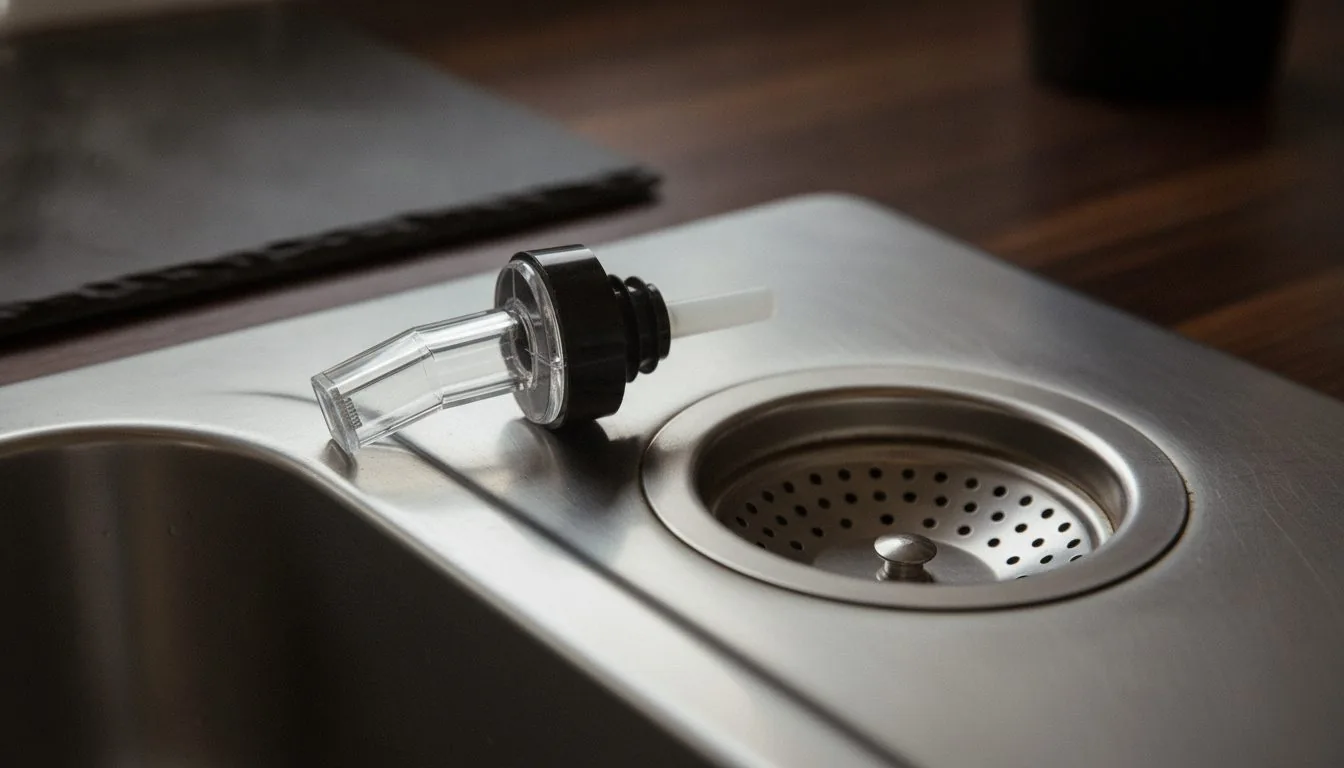
Esatto does not sell drain cleaners. It does make and sell the Esatto Liquor Pourer with Screen, 12 Pack. It is our own product, not an independent pick. Its page describes a built-in screen that acts as a protective barrier, keeping bugs and debris out of your liquor. That is about the bottle. It does nothing for a drain and does not control fruit flies on its own. It is a free-flow pourer, so if you are comparing spouts, see free-flow versus measured pourers and the screen pourers collection. The older post on keeping flies out of bottles covers the rest.
Frequently asked questions
How do I get rid of fruit flies in a drain?
Clean the slime they feed in. Oregon State recommends a bacterial or enzymatic drain cleaner followed by hot water, and daily washing of catch baskets. Cover the drain overnight afterward to test it.
What kind of fruit fly drain cleaner should a bar use?
One the sources describe as biological: bacterial or enzymatic, or a foam formulation. In a food business, follow its label and check that the label allows that use.
How do I clean drains to get rid of fruit flies?
Wash the catch baskets, apply a biological cleaner as its label says, flush with hot water, and keep bottles and glassware out of the splash. Only scrub when the kitchen is not in use.
Does a caustic drain opener get rid of fruit flies?
Oregon State says caustic, lye-based drain cleaners are not as effective as enzymatic cleaners for this job and recommends avoiding them. Whatever you use, the label governs.
Can I pour bleach down the drain for fruit flies?
Oregon State says bleach and other disinfectants are not effective on the drain slime, and that bleach with hot water releases dangerous chlorine gas. Do not combine products. Follow the label.
How can I tell if the flies are coming from the drain?
Cover the drain overnight with clear tape or a clear container with a sticky card inside. If flies are caught, the drain is a source. If not, check fruit, recycling and drip trays.
Are drain flies the same as fruit flies?
No. Drain flies are fuzzy and moth-like and their larvae live in drain slime. Fruit flies have red eyes and breed in fermenting fruit and liquids, though one species also uses drain slime.