Fruit Fly Eggs and Larvae: How to Spot Them at a Bar
Quick Answer: Fruit flies lay eggs on the surface of overripe fruit and fermenting liquid, so look where food or liquid sits wet and undisturbed. The larvae are whitish or pale, legless and small, and University of Maryland Extension says the whole cycle from egg to adult takes 8 to 10 days. Remove the food and moisture where you find larvae. Sanitation is the primary control.
Seeing a few adult flies means eggs are probably already somewhere nearby. Finding the larvae tells you where. This post covers what eggs and larvae look like, where a bar should check first, and what to do next. For the full list of food sources, see where bar fruit flies come from, and for small flies that are not fruit flies, see fruit gnats vs fruit flies.
Where do fruit flies lay their eggs?
On the surface of food or fermenting liquid. University of Maryland Extension (checked October 2026) says the female lays eggs on the surface of the food or fermenting liquid, and that adults are drawn to overripe fruit and vegetables, fermenting foods, wine, beer, juice and vinegar. Oregon State University Extension (checked October 2026) says females lay eggs on or near suitable food. The UF/IFAS Extension Polk County page (checked October 2026) says the eggs are white and oval and hatch in the fruit they are laid on.
What do fruit fly larvae look like?
Whitish or pale, legless and tapered at one end. The extension sources agree on that and differ on size, so the table gives each source's figure.
| Stage | What the source says | Source |
|---|---|---|
| Larva | Whitish, 1/4 inch long, eyeless and legless, tapering toward the head | University of Maryland Extension |
| Larva | Pale orangish, translucent or whitish; mature larvae 1/12 to 1/8 inch (2 to 3 mm); a forked breathing tube at the rear | UC IPM |
| Pupa | Generally brownish, with forked breathing tubes at the rear; found in, on or near damaged fruit | UC IPM |
| Feeding time | 5 to 6 days, then they crawl to drier areas to pupate | University of Maryland Extension |
| Feeding time | About 4 days as a larva, then about 4 days as a pupa | UF/IFAS Extension Polk County |
The size figures disagree, and the UC IPM page (checked October 2026) covers several kinds of fruit fly, so treat any size as a rough guide. Do not rely on size alone to decide what you are looking at.
Where should you look for larvae in a bar?
Wherever something wet and sugary stays put. These are places the sources name, and the order is a sensible way to check them.
| Place | What the source says | Source |
|---|---|---|
| Floor and sink drains, overflow drains, disposals | Biofilms form quickly and create areas for fruit flies | Oregon State |
| Under antiskid floor mats | Biofilms also form there | Oregon State |
| Recycling bins, cans and bottles | Loose-lidded juice and vinegar containers; sweet residue is especially alluring | Oregon State; Washington State |
| Mops, towels, sponges | Damp ones may hold enough food and moisture to complete development | University of Maryland; Washington State |
| Fruit and garnish | Larvae feed in damaged or fermenting, overripe fruit | UC IPM |
For drains in particular, see fruit flies in bar drains. Oregon State also says to check decomposing fruit and vegetable matter in kitchen equipment and hard-to-reach areas.
What should you do when you find larvae?
Remove what they are feeding on, then clean the spot. University of Maryland Extension says the primary control for fruit flies is sanitation, and to eliminate larval food and development sites. Washington State University Extension (checked October 2026) adds that killing adults has little impact on the potential future population, and that the adults seen in a kitchen have likely already laid eggs. It recommends eliminating the fruit sources and cleaning often.
If you plan to use a spray or any pest product in a food business, the FDA Food Code 2026 (§7-202.12, checked October 2026) says a pesticide must be used according to label instructions that state use is allowed in a food establishment. The Code is a model, and your local health department's adopted version binds your bar. Do not serve a drink that has a fly in it; a fruit fly in a drink covers what the sources say about that.
When is a screen pourer the wrong choice?
When the problem is already inside the bar. A screen sits in a bottle's neck; it does nothing about film on the neck, larvae in a garnish tray or slime in a drain. That is cleaning work. Screen pourers are also a poor fit for a bottle you pour from once a month with its original cap.
Where the Esatto Liquor Pourer with Screen, 12 Pack fits
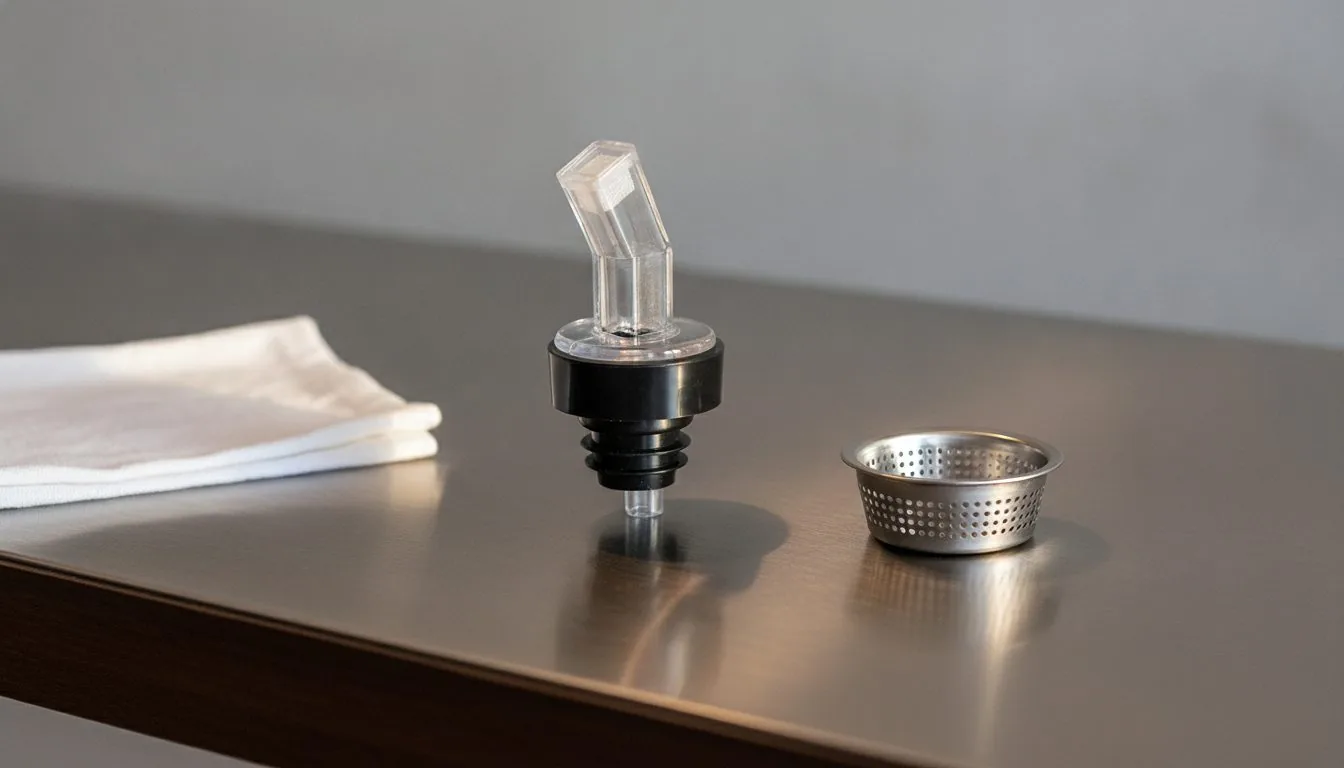
Esatto makes and sells the Esatto Liquor Pourer with Screen, 12 Pack. It is our own product, not an independent pick. Its page describes a free-flow pourer with a built-in screen that keeps bugs and debris out of your liquor. That is all it claims, and it is not a fruit fly control. Sanitation comes first. The screen pourers page lists the pack sizes.
Frequently asked questions
Where do fruit flies lay eggs?
On the surface of food or fermenting liquid, according to University of Maryland Extension. Oregon State says on or near suitable food. In a bar, that means fruit, spills, residue and drain slime.
Do fruit flies lay eggs on fruit?
Yes. UF/IFAS Extension Polk County says the eggs are laid on fruits and vegetables and hatch there. UC IPM says most of the species it covers do not feed in undamaged fruit, so damaged or overripe fruit is the concern.
What do fruit fly larvae look like?
Whitish or pale, legless, and tapered toward the head, per University of Maryland Extension and UC IPM. Sizes differ by source, from 1/12 inch to 1/4 inch.
How long do fruit fly larvae take to become adults?
University of Maryland Extension says the whole life cycle takes 8 to 10 days, with larvae feeding 5 to 6 days. UF/IFAS Extension Polk County gives about a week in favorable conditions.
What do fruit fly droppings look like?
None of the sources read for this post describes fruit fly droppings. Look for the larvae, damp residue and the food source instead, since those are what the sources describe.
What do fruit fly pupae look like?
UC IPM says pupae are generally brownish and have forked breathing tubes at the rear. They are found in, on or near damaged fruit where the larvae fed.